


Nothing beats hard work.
Every single coach I worked with throughout my athletic career instilled this mentality in me.
Here's what hard work meant to me until I was around 22:
More is ALWAYS better
Rest was for losers
Grit is the difference between mediocrity and success
The difficult things must be done, despite the circumstances
But I couldn't have been more wrong.
My perception of hard work was incomplete — and I paid the price.
Despite lacking perspective, I found success with this mentality early on (which only bolstered my half-baked beliefs).
I was far from the best player in the early years of my high school baseball career.
I wasn't promoted to my high school's varsity baseball team until my senior year.
And even still, this was likely out of courtesy, not skill level.
When I became a senior, a sudden realization hit me:
If I was hardly good enough to play on a varsity baseball team, my childhood dream of playing professional baseball wasn't going to happen.
I saw the baseball career I'd devoted countless hours to coming to a close.
So I got serious.
I applied the lessons in hard work I'd learned from my coaches as I understood them.
After a year of working my a** off, I'd gone from being a mediocre player to securing a roster spot at a D1 collegiate program — something just 2.4% of high school baseball players accomplish.
In other words, I got miraculous results — at first.
The results didn't last.
While it might seem counterintuitive, the perception of hard work that got me further than most also ended my career early.
But how could "hard work" have been detrimental to my career?
Let me explain:
Once I got to college, I knew other players of equal skill were vying for the same goal I had — to play in the major leagues.
So how could I ensure it was me who was drafted by a major league team instead of the others?
The answer in my mind was exactly what I had worked for me in the past:
Outwork everyone else.
So I did — I devoted my spare time to doing as many reps as I could.
But my focus was completely lopsided.
I did copious amounts of reps, but I didn't assign the same amount of urgency to my recovery.
With each rep I did, I built up excess wear and tear that I never addressed — my chances of injury rose higher and higher.
I was a ticking time bomb.
And it led to breaking points.
Every.
Single.
Time.
I could never seem to stay on the field or in the weight room.
I suffered injury after injury:
Torn UCL (ulnar collateral ligament in my elbow)
Strains of all kinds (tricep, rotator cuff, lower back, hamstring)
Knee tendinitis (prevented me from building any real lower body strength)
My repeated injuries cost me my consistency.
I lost the ability to make progress daily and have each small breakthrough eventually compound into success.
But what caused me to be an injury magnet in the first place?
The answer is simple: I overtrained.
I pushed myself too hard, too often.
I failed to respect the fine line between hard work and overtraining.
I never acknowledged that performance gains aren't made during your training — they're made while you rest and recover.
I never asked myself:
Am I fully recovered from my last training session?
When is it smarter not to push through — am I seeing diminishing returns?
At what point does my training become detrimental to my performance?
All in all, my perception of hard work lacked nuance.
After 3 1/2 years of fighting off injuries, I finally decided to hang up my cleats — without ever pitching in a single game for the team.
The most regrettable part of it all?
If I'd known what I know now, I could have changed the outcome of my athletic career.
Your body's readiness to train can actually be quantified through a metric called heart rate variability (HRV).
With HRV, you can optimize your workload and recovery routines to prevent overtraining, reduce injuries, and track your improvement at the same time.
The fitness tracker I wore during my playing career gave me this data right at my fingertips.
Yet, I ignored the data because I accepted the false pretense that I just needed to keep pushing through, regardless of the circumstances.
In this article, I'll show you how my perception of hard work and training has evolved through the incorporation of HRV.
It's my hope that this knowledge helps YOU make more intelligent decisions when it comes to your training volume, intensity, and recovery.
What Is HRV?
To explain HRV, we'll start by introducing a different metric: heart rate.
Most people have heard of this metric before — it's a simple measure that tracks how many times our heart beats per minute.
But here's what you might not know: the amount of time between these beats isn't equal.
Take a heart rate of 60 bpm (beats per minute) as an example:
Given that there are 60 seconds in a minute, if the duration between each of your heartbeats was equal, each beat would happen exactly once per second.
But this isn't reality (and as you'll later learn, isn't ideal).
If you monitor your heartbeats through an ECG machine, you'll quickly find that the duration between each heartbeat isn't the same.
One set of beats might have 0.95 seconds between them, while the duration between the next set of beats might be 1.05 seconds.
This means the duration between your heartbeats has variability.
You can measure this variability in a metric called heart rate variability (HRV).
![What is Heart Rate Variability (HRV)? [The Ultimate HRV Guide]](https://substackcdn.com/image/fetch/$s_!I-Mz!,f_auto,q_auto:good,fl_progressive:steep/https%3A%2F%2Fsubstack-post-media.s3.amazonaws.com%2Fpublic%2Fimages%2Fb57ca855-fdc1-4e24-9a64-20b059670475_615x393.png "What is Heart Rate Variability (HRV)? [The Ultimate HRV Guide]")
So what causes this variability?
HRV stems from your nervous system — particularly, your autonomic nervous system.
Your autonomic nervous system controls the involuntary actions we take for granted throughout our day-to-day lives.
Thanks to the autonomic nervous system, you don't have to consciously think about:
sweating
breathing
producing saliva
digestion
and most relevantly, adjusting your heart rate
Your autonomic nervous system is made up of two branches which counterbalance each other:
Sympathetic (SNS) - promotes fight or flight response (stay alive)
Parasympathetic (PNS) - promotes relaxation & energy conservation (rest & digest)
The SNS and PNS systems work together as your body's resource management system (and are also responsible for HRV).
Your body doesn't have unlimited amounts of the resources it needs to function, so naturally, your body has to make sure it's allocating its resources efficiently and effectively.
When one system (PNS or SNS) needs resources, they're siphoned off from other bodily processes where there isn't an immediate need for them.
Let's say a sabertooth tiger begins charging toward you.
Your SNS (responsible for fight or flight response) will immediately kick into overdrive.
You'd see all of the following bodily changes in an instant:
increased heart rate
increased respiratory rate
increased adrenaline production
increased pupil dilation
Because of this sudden uptick in demand for energy by your SNS, your body must temporarily borrow the energy from other sources that aren't immediately necessary for survival.
In other words, bodily functions important for long-term health and recovery are temporarily suppressed in favor of avoiding death in the present moment.
Considering you could be seconds away from being mauled, this is exactly how you want your body to manage its resources.
As a result, you'd see the energy allocation to the following bodily functions dry up:
decreased digestion
decreased immune system activity
decreased urine production
decreased reproductive functions
Let's say the energy your SNS siphoned off was enough to help you successfully escape from — or even fend off — the sabertooth tiger.
What happens when there is no longer an immediate threat and life returns to normalcy?
When an elevated SNS is no longer necessary, the strength of the signal it sends to the rest of your body will begin to decline.
At the same time, the PNS, which regulates the maintenance activities that your body performs for you (like digestion, immune system activity, etc) and is primarily active at rest, will increase the strength of its signal.
This reversal in signal strength reallocates the energy needed for your fight or flight response back to the bodily functions necessary for maintenance, long-term health, and recovery.
This brings your body back into homeostasis (balance).

Throughout your daily life, the SNS and PNS are constantly competing with each other to regulate your body's resources in a tug-of-war type fashion.
As you learned above, this power struggle affects your heart rate.
In a healthy individual, these systems send simultaneous signals to your heart via neurotransmitters — to both speed up and slow down your heart rate.
Your heart seeking to accommodate two different signals at the same time results in a heart rate with variability in the timing between each beat: HRV.
Why Is HRV Important?
Now that you understand the systems that govern your HRV:
Why is your HRV even worth tracking?
And how should you interpret your HRV readings?
Here are the answers:
HRV has been shown in numerous studies to:
positively correlate with athletic performance and training adaptation
negatively correlate with the risk of overtraining and injuries
In other words, when your HRV is higher:
your performance goes up
your chances of overtraining or injury go down
For these reasons, using HRV as a guide to dynamically structure your workout intensity, volume, and recovery activities can be extremely beneficial to you.
So how can you actually derive insights about your readiness to train from HRV?
Before you can obtain any meaningful information from your HRV measure, you first need to track your HRV over several days to identify your personal baseline.
Once you have an established baseline, you'll be able to compare it to your current HRV measure to determine your body's relative readiness to train.
Important note:
Even though you can continuously monitor your HRV data throughout the day (your heart is always beating), you should instead take a single measurement at a standardized window of time each day, typically one when you'll always be at rest.
As you'll soon learn, HRV fluctuates greatly throughout the day for a wide range of reasons, so isolating a constant window of time to take the measurement is critical to ensuring it's meaningful.
I'll be diving further into the best practices and nuances when tracking HRV in the next section.
But for now, let's stick to illustrating how to interpret HRV by walking through an example:
Let’s say you’ve got a training session scheduled for after you’ve finished reading this newsletter.
After you've done your workout, you finally get in bed for a well-deserved night of sleep.
When you wake up the following morning, your HRV reading will be in one of three categories:
Above baseline
At baseline
Below baseline
We'll play out each of these different scenarios below:
HRV Above Baseline

When your HRV reading as measured during your rested window is higher than your usual baseline, it indicates your body is in a well-recovered state and primed for physical exertion.
But why is this the case?
The higher the variability in your heart rate, the more responsive your heart is to both SNS and PNS signals.
This is a sign that your autonomic nervous system is balanced — neither the SNS or PNS is crowding the other out.
The more balanced your SNS and PNS are at rest before training, the more potential the SNS has to rise to the occasion when you begin to train.
Knowing this, you can feel confident in proceeding with your planned training session and even consider increasing the intensity or duration if you feel up to it.
However, as mentioned above, it's extremely important to take your HRV measurement during an isolated window of time when you are in a RESTING state.
If you fail to measure your HRV during the appropriate conditions, your interpretation of your body's readiness to perform may be wildly off.
Let's explore how this is possible:
If you measure your HRV when your SNS is highly active (during a workout), your HRV will be much lower than it actually is at rest.
Just like the interaction with a sabertooth tiger, intense exercise will activate the SNS to prepare your body for increased physical demands.
Recall that the variability in your heart rate is caused by a tug-of-war between the SNS and the PNS.
When both systems propagate signals of roughly equal strength, you'll have a higher HRV.
If the SNS signals start to overshadow the PNS, the PNS signals won't be as competitive in regulating your heart rate anymore.
The stronger signals from the SNS overpower the signals from the PNS, increasing your heart rate and actually lowering your HRV.
During an acute activity like exercise, a lower HRV is good — it's exactly what you should want.
As you recover, your HRV will increase as your SNS and PNS signals gradually become balanced again.
So what's the main takeaway here?
If you measure your HRV at the wrong time (during a workout), you'll be deluded into thinking your body isn't prepared for its next workout and needs more rest.
In reality, your body could easily return to having an HRV equal to or higher than baseline when it enters a renewed state of rest, signaling that you are primed to perform.
HRV At Baseline
When your HRV as measured during a resting state is roughly equal to its usual baseline, you've got the green light to work out at a similar intensity that day.
Just like having an HRV above baseline, it's a sign that the recovery you're doing to prepare yourself for your next workout is adequate.
However, you likely don't want to push your intensity any further without beefing up your recovery procedure as well — this will likely have a negative impact on your HRV.
In other words, you're doing everything right — keep doing what you're doing.
HRV Below Baseline

When your HRV as measured during a resting state is significantly lower than your usual baseline, it's a signal that you likely haven’t fully recovered from the prior day’s training.
As illustrated in the section discussing an HRV above baseline, a low HRV isn’t always cause for concern.
It's completely normal to have a low HRV during acute exercise — your HRV will decrease as your body further activates the SNS to meet the demands placed on your body through training.
The issue arises when your HRV is chronically low — when your HRV is low at rest.
If your HRV is low outside your time spent exercising, it’s a strong indication that there are other factors causing extra stress to your body:
fatigue
dehydration
mental stress
illness
Take the last bullet point as an example:
When your body is already working hard to fight an illness, you have fewer resources available to assign to exercising or cognitively challenging tasks.
If you decide to go sprinting while you have a fever, your body isn’t going to perform well relative to if you were healthy.
Your body can't just decide to stop fighting the illness because you’ve decided to exercise — fighting it off is a pressing matter.
When your HRV is low at rest, your SNS is preoccupied and has fewer potential resources to allocate to your training.
In the absence of illness, waking up with a low HRV can signify that your body is dealing with other forms of wear and tear.
With this information, you can derive several insights you can use to tailor your approach to ensure you're optimizing your recovery.
First, you can experiment with adjusting the following variables in your training regimen:
intensity
volume
frequency
For the average person training with the broad goal of bettering their overall health, these variables are flexible and can be changed as needed.
For example, if you find yourself unable to adequately recover from highly intense workouts, but still want to hit the gym 5 days a week, then you should consider lowering the intensity of each workout so you can better meet your body's recovery requirements.
However, many athletes participate in competitive settings where intensity is not negotiable.
For example, if you're expected to participate in a marathon, the intensity is fixed.
In this circumstance, you'd lower your workout intensity and volume ahead of the event to ensure your HRV is at its peak before the event (for optimal performance), then use your HRV reading the morning after the event to assess your recovery status.
If your HRV is low (as you'd expect), you can use this as confirmation that your body needs much more rest before you begin to train again, preventing you from chronically overtraining and eventually sustaining injuries.
A low resting HRV is also an indicator that you'd likely benefit from placing more emphasis on the other side of the equation — your recovery.
I'll be writing in-depth on the benefits of being attentive to areas like your sleep, nutrition, and hydration for your HRV in the final section of this newsletter.
How Can You Track Your HRV?
Now that you're aware of how you can properly interpret your HRV to your benefit:
How should you actually go about tracking it?
There are several best practices to keep in mind:
Selecting A Measurement Window
Most modern fitness wearables like WHOOP, Garmin, and Apple Watch come with a built-in capability to continuously measure your HRV.
But as you've already learned, it's best to measure your HRV during an isolated window of time where conditions are always the same.
When you first begin to track your HRV with a wearable, you'll notice the following:
Your HRV fluctuates A LOT.
There are a multitude of variables that can influence your HRV to a large degree:
Training - oscillation between training and recovery affects HRV
Breathing - a slower, more controlled respiratory rate can increase HRV, while rapid, shallow breathing may decrease it due to increased sympathetic nervous system activity
Hydration - inadequate hydration can lead to decreased blood volume and increased heart rate, both of which can negatively impact HRV
Diet - meal quality and quantity can both influence HRV
Alcohol - a single night drinking can reduce your HRV for up to 5 days
Sleep - maintaining high-quality, consistent sleep is beneficial for HRV, while poor sleep quality and inconsistent sleep times can decrease HRV
HRV’s ability to synthesize so many distinct inputs makes it a powerful metric, but its generalized nature can also be viewed as a weakness.
Your HRV fluctuates dramatically throughout the day for a plethora of reasons, making it nearly impossible to capture the exact context of why these movements are occurring.
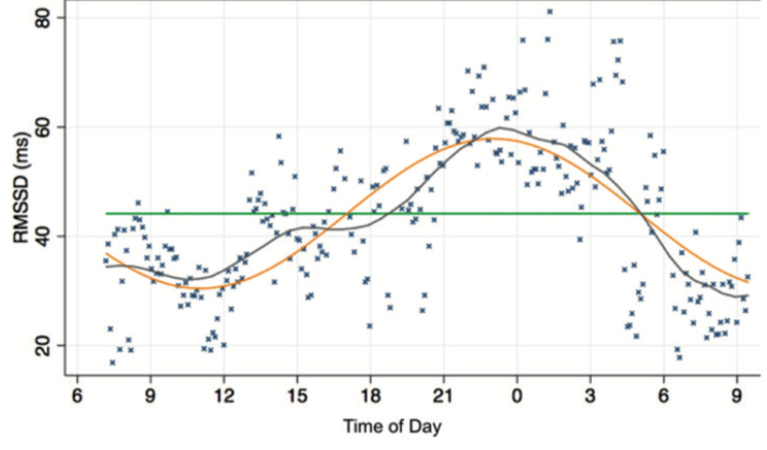
Essentially, you'd have to track every single thing you did every day in excess in order to meaningfully interpret your continuous HRV data.
For the purposes of assessing your body’s readiness to perform, you simply don't need to add this level of complexity.
By controlling for all the external variables using a defined collection window in a rested state (as mentioned before), we can take a clean look at your HRV without all the noise.
So how can you go about choosing a proper window to track your definitive HRV measurement for the day?
The consensus view amongst researchers is to measure your HRV first thing in the morning.
By measuring HRV first thing in the morning, we can create a consistent baseline that is affected by the smallest number of environmental factors possible.
However, there are some issues with this approach:
heart rate typically increases when you know you're being measured
even minimal physical movement or cognitive activity can influence HRV
Luckily, you don't have to measure your HRV consciously.
Wearables can passively track your HRV while you sleep, thus avoiding even greater amounts of "noise" caused by environmental factors.
Fitness wearable company WHOOP uses its sleep-stage tracking technology to isolate your HRV throughout each stage, calculating your overall HRV using a dynamic average.
They emphasize your deepest periods of sleep to maximize consistency and accuracy.
To make your interpretation of your HRV value easier and free of noise, WHOOP only shows you the dynamic average they calculate from your time asleep.
While other devices like Garmin do allow you to view your HRV in real-time, using an average of your HRV throughout your time asleep still gives you a much clearer and concise picture of your recovery status.
Baseline HRV Improvement Over Time
As we've discussed above, before you can garner any insights from your HRV measurement, you need to have established a baseline.
Your initial baseline measurement should be the average of your HRV as measured during your defined window over at least a couple of days.
However, you shouldn't stop with just the initial baseline.
You must continue to calculate new baselines periodically if your fitness wearable doesn't already do this for you.
But why is this necessary?
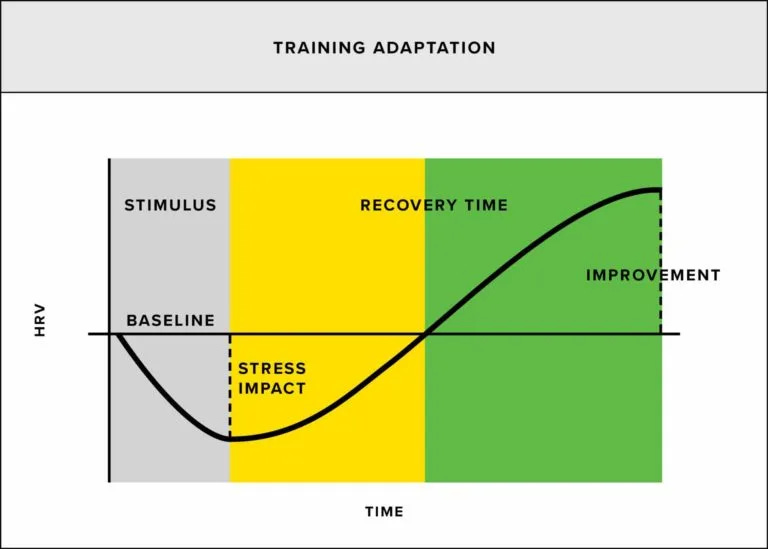
As a byproduct of both optimizing your training and recovery routines and increasing physical fitness that will come from your workouts, you'll begin to see your baseline HRV trend upward.
In other words, your baseline HRV will continue to evolve over time.
Just like a muscle, your nervous system responds to stimulus, recovers, and then shows increased resiliency once recovery is complete.
Here's a simplified chart showing how the process works:
HRV Comparisons Between People
Throughout this newsletter, I've been careful to say that a higher HRV is ideal — not a high one.
The reason for this is the following:
Heart rate variability is an extremely individualized metric that often differs significantly from one person to another.
For example, two elite athletes with approximately the same level of fitness can have a completely different HRV.
But how can this be the case?
Genetics and age are the two factors outside of exercise that play the largest role in determining your HRV.

In the above chart, you can see the effect that age has on the HRV values of the middle 50% of the population.
As age increases, your HRV begins to decline.
You can also use the chart to observe the wide range that HRV varies due to genetics and differences in training.
This chart shows only the middle 50% of the population, meaning there are many outliers both higher and lower than this range.
While athletes well-trained athletes do tend to have higher HRV values due to their training, genetics plays such a large role in determining your HRV that comparison on a population level isn't meaningful.
For this reason, HRV isn't a metric you should be comparing from person to person.
Instead, your HRV should be used as a personal marker to track your own improvement.
In other words:
when we compare between people, a higher HRV value doesn't hold much weight
on an individual level, a higher baseline HRV over time is a sign of fitness improvement
So now that you've understood the value in tracking HRV, isolated a measurement window, and are aware of interpretation best practices:
What behaviors should you implement in your daily life to maximize your HRV?
How Can You Improve Your HRV?
What are the biggest levers you can pull to maximize your HRV?
Every action you can take toward maximizing your HRV falls into one of two categories:
Training Optimization
Recovery Optimization
We've already discussed how optimizing the intensity, volume, and frequency of the workouts in your training routine allows you to recover more effectively from your workouts, increasing your HRV.
But throughout this newsletter, we haven't yet been specific about what a quality recovery actually entails.
Here are the core building blocks of a recovery routine that will keep your HRV, and by extension, your body's readiness to perform at the highest they can be:
Rest: Ensure you get enough sleep (8-9 hours) and incorporate rest days into your training schedule to allow your body time to adequately recover and prevent overtraining.
Nutrition: Consume a balanced diet rich in protein, carbs, and healthy fats.
Amino acids from proteins are vital for the synthesis of neurotransmitters and enzymes that regulate autonomic functions, influencing HRV.
Carbohydrates replenish glycogen stores depleted during exercise, ensuring a stable energy supply, reducing physiological stress, and supporting a balanced autonomic nervous system, thereby enhancing HRV.
Healthy fats reduce inflammation and support cell membrane integrity, which can improve HRV by promoting better heart function and autonomic balance.
Hydration: Dehydration can impair cardiovascular function, increase heart rate, and reduce stroke volume, leading to lower HRV.
Electrolyte Balance: Maintaining proper electrolyte levels, especially sodium, potassium, and magnesium, is crucial to enhancing HRV.
Alcohol Avoidance: Alcohol consumption has a noticeable negative impact on HRV, with a single night out drinking causing a reduction in your HRV for up to 5 days.
Mental Wellness: Incorporating techniques such as meditation, deep breathing exercises, or hobbies can increase HRV by lowering your stress level.
Aside from the core aspects listed above, other activities can provide a marginal benefit to your HRV:
Active Recovery: Engage in low-intensity activities such as walking, stretching, or yoga. This can help increase blood flow to muscles, reduce soreness, and promote healing.
Proper Warm-Up and Cool-Down: Incorporate proper warm-up routines before training to prepare your muscles and a cool-down routine afterward to help your body gradually return to a resting state.
Stretching and Flexibility Work: Stretching can help improve flexibility, reduce muscle stiffness, and prevent injuries.
Massage and Foam Rolling: These techniques can help release muscle tension, improve blood flow, and reduce soreness.
While there's a practical limit to the amount of recovery you can do, seeking to maximize your recovery is a good rule of thumb.
When you don't neglect the areas listed above, you give your body the chance to handle workloads your body might have otherwise had difficulty with before.
To wrap things up, here's my final advice to you:
Hit your workouts with intensity and be willing to push yourself to new heights, but don't neglect the activities that are critical to your recovery.
Use HRV as your gauge to determine your body's readiness to perform.
When you adhere to this approach, you won't succumb to overtraining.
You'll be able to stay consistent, allowing your training sessions to compound into eventual success.
Until next time.
— Landon